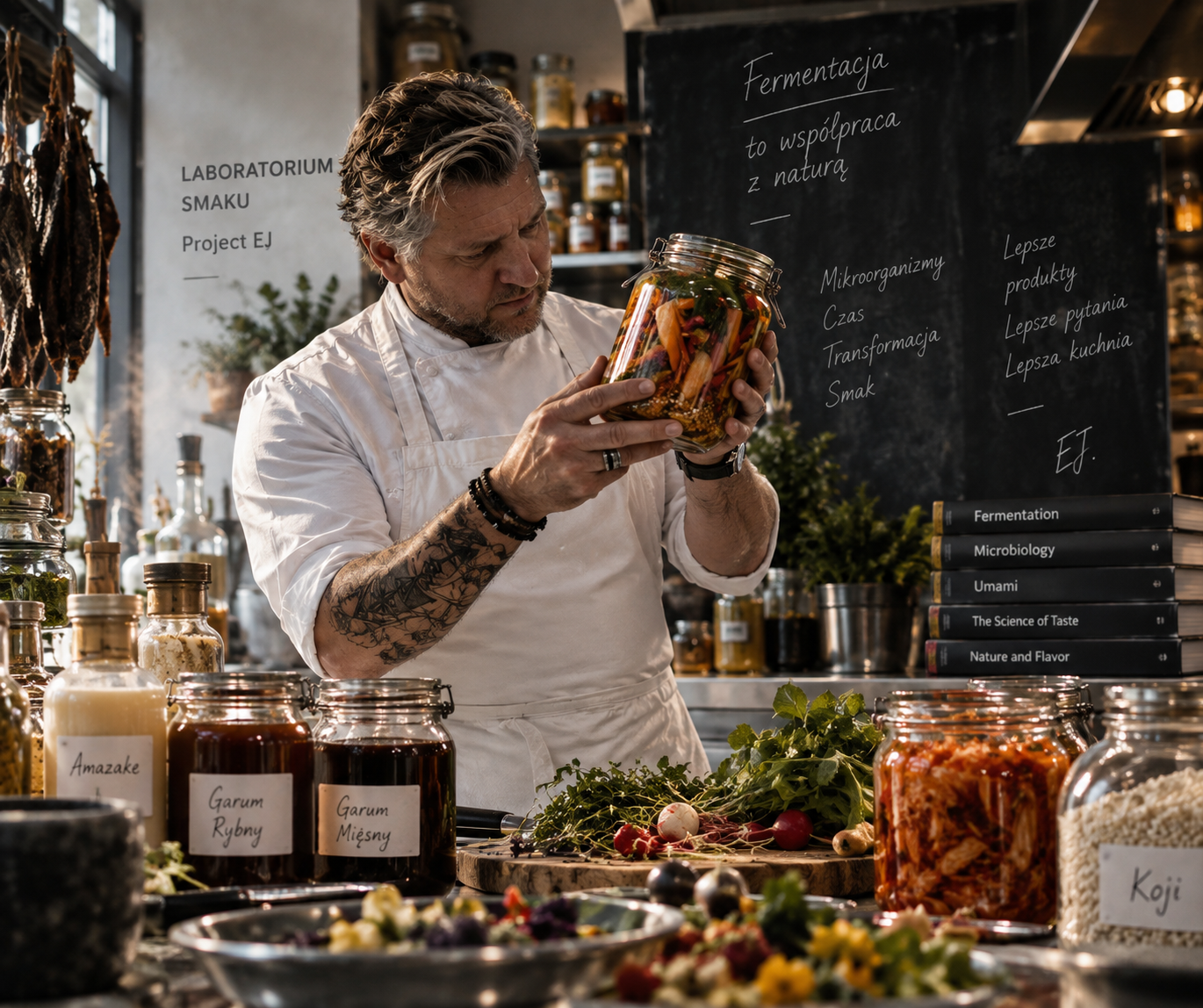
Can Fermentation Replace Salt?
Ernest Jagodziński
When a dish lacks flavour, a chef’s first instinct is often to reach for salt.
It is one of the first gestures we learn in the kitchen.
Taste.
It needs salt.
Add some.
Taste again.
And yes—salt can change everything.
But after many years in the kitchen, I increasingly find myself asking a different question:
Are we really missing salt?
Or are we missing something else?
Depth.
Complexity.
Umami.
Aroma.
Time.
Perhaps the problem is not that the dish is not salty enough.
Perhaps we simply have not allowed it enough time to create its own flavour.
Salt is only the beginning
Salt is one of the oldest tools in the chef’s kitchen.
It preserves. It changes texture. It influences structure. It can enhance the perception of other flavours, soften bitterness, highlight sweetness and make aromas feel more pronounced.
But salt does not create the whole experience.
Very often, it simply helps us reveal what is already there.
And this is where the fascinating world of fermentation begins.
Fermentation is not simply the addition of another seasoning.
It is a process.
A process in which microorganisms transform the environment in which they live.
They consume certain compounds and produce others.
They transform sugars, proteins and other components of food.
They create acids, alcohols, gases and countless compounds responsible for aroma and flavour.
It is almost as if the ingredient begins to tell its own story.
Only instead of words, it speaks through chemistry.
Invisible chefs
The more I work with fermentation, the more fascinated I become by the fact that what we see on the surface is only a small part of what is actually happening.
A jar of fermented vegetables looks almost ordinary.
Rice covered with koji may appear to be nothing more than a grain with a delicate white layer.
But beneath that surface, an extraordinary number of processes are taking place.
Microorganisms are working.
Enzymes break larger molecules into smaller ones.
Proteins are transformed into compounds that can contribute to umami.
Starches can be broken down into simpler sugars.
New aromas emerge.
Acidity changes.
Texture changes.
And our perception of the ingredient changes with it.
This is why fermentation, to me, is much more than a preservation technique.
It is a form of collaboration.
Do microorganisms communicate with us?
It sounds almost philosophical.
Of course, bacteria, yeasts and fungi do not communicate with humans in the way people communicate with one another.
But there is something even more fascinating we can say.
They communicate through chemistry.
They transform their environment, and we are able to read those changes through our senses.
Acidity.
Aroma.
Umami.
Texture.
Gas.
Temperature.
All of these are information.
A microorganism performs its work, and we experience the result.
In a sense, it becomes a dialogue.
Not a dialogue made of words.
A dialogue made of molecules.
This is what fascinates me most about fermentation.
Koji
Koji is one of the best examples of this invisible world.
Rice, barley or another grain becomes a substrate for a microorganism that produces enzymes.
And those enzymes begin to work.
They break down starches.
They act on proteins.
They transform the structure of the ingredient.
They create the conditions for new flavour compounds to emerge.
Suddenly, an ordinary grain is no longer simply a grain.
It becomes the beginning of something entirely new.
And this is where we begin to understand something important:
Fermentation does not simply add flavour.
Fermentation changes the material from which flavour is created.
That is a profound difference.
Can fermentation replace salt?
Not always.
And that is not really the point.
Fermentation cannot make an ingredient taste as salty without salt.
But it can make us realise that we may not need as much salt for a dish to feel complete and full of flavour.
That is a very different idea.
Imagine two broths.
The first is seasoned with more salt.
The second contains less salt, but also includes a fermented ingredient rich in compounds that contribute to umami and aromatic complexity.
If we ask only:
“Which one is saltier?”
the answer is obvious.
But if we ask:
“Which one feels deeper, more intense and more complete?”
we are talking about something entirely different.
Perception.
And this is where the chef meets science.
Time as an ingredient
Fermentation also teaches us patience.
Modern gastronomy often wants to accelerate everything.
Faster.
More efficient.
Immediate.
Microorganisms, however, have their own rhythm.
We cannot convince them to work faster simply because the restaurant service starts in three hours.
We can create the right conditions.
We can control temperature.
Humidity.
Time.
Substrate.
Salt concentration.
But then we have to allow the process to happen.
Perhaps that is why fermentation is also a lesson for the chef.
Not everything can be done by hand.
Not everything can be controlled.
Sometimes we have to create the right conditions and allow nature to do its work.
Fungi, bacteria and us
The more I learn about microorganisms, the more my view of the kitchen changes.
For years, I looked at an ingredient primarily as something to be prepared.
Today, I increasingly see it as a living system of processes.
Fungi.
Bacteria.
Yeasts.
Enzymes.
Invisible collaborators in the creation of flavour.
They do not compete with the chef.
They do not take control away from us.
They give us more tools.
And the best chef does not have to do everything alone.
The best chef needs to know when to let others do the work.
Perhaps the question is not about replacing salt
Maybe we have been asking the wrong question.
Not:
Can fermentation replace salt?
But:
Can we learn to build flavour differently?
That question is much more interesting to me.
Because the future of gastronomy may not be about adding more and more ingredients.
It may be about understanding more deeply the processes that are already taking place within them.
Fermentation does not diminish the importance of salt.
It simply teaches us that flavour can be built in many different ways.
And that sometimes the best way to season a dish is to let it work.
For years, we have learned how to season food.
Today, I am increasingly interested in something else.
How can we allow an ingredient to begin creating its own flavour?
Perhaps that is where the future of cooking begins.
Not with more ingredients.
But with a deeper understanding of the ones we already have.
“Not everything that creates depth of flavour needs to be added. Sometimes, we simply need to let nature create it.”