When Spain Reinvented Taste – and Why This Story Matters More Than Ever
At the time, I had no idea that I was witnessing a moment in culinary history.
It must have been sometime in the late 1990s. I was a young chef travelling with colleagues to a trade fair in Hamburg. On a small stage stood a man who, at the time, was still largely unknown outside the world of haute cuisine.
His name was Ferran Adrià.
In front of the audience, he presented a carbonara – but not as any of us knew it. There were no traditional spaghetti on the plate. Instead, he recreated the familiar flavours in a completely new texture. Shortly afterwards came espumas: light, airy and, for many of us at the time, almost unimaginable.
It felt as though the rules of cooking were being rewritten before our eyes.
Back then, many of us did not fully understand what was happening. Today, we know that we were witnessing a culinary revolution.
But this revolution did not begin with Ferran Adrià alone.
As early as the 1970s, Juan Mari Arzak and the Nueva Cocina Vasca laid the foundation for a new generation of Spanish chefs. Tradition was not meant to be replaced. It was meant to be understood, questioned and developed further. Classic recipes were transformed into modern interpretations without losing their cultural roots.
Perhaps that was Spain’s greatest strength: a generation of extraordinary chefs had the courage to challenge the familiar without losing respect for their own culinary identity.
During the 1980s and 1990s, Ferran Adrià took this development to an entirely new level. At elBulli, cooking was no longer just about preparing food.
It became a form of research.
Why does something taste the way it does? What roles do temperature, texture and consistency play? How does our perception change when a familiar dish suddenly looks completely different?
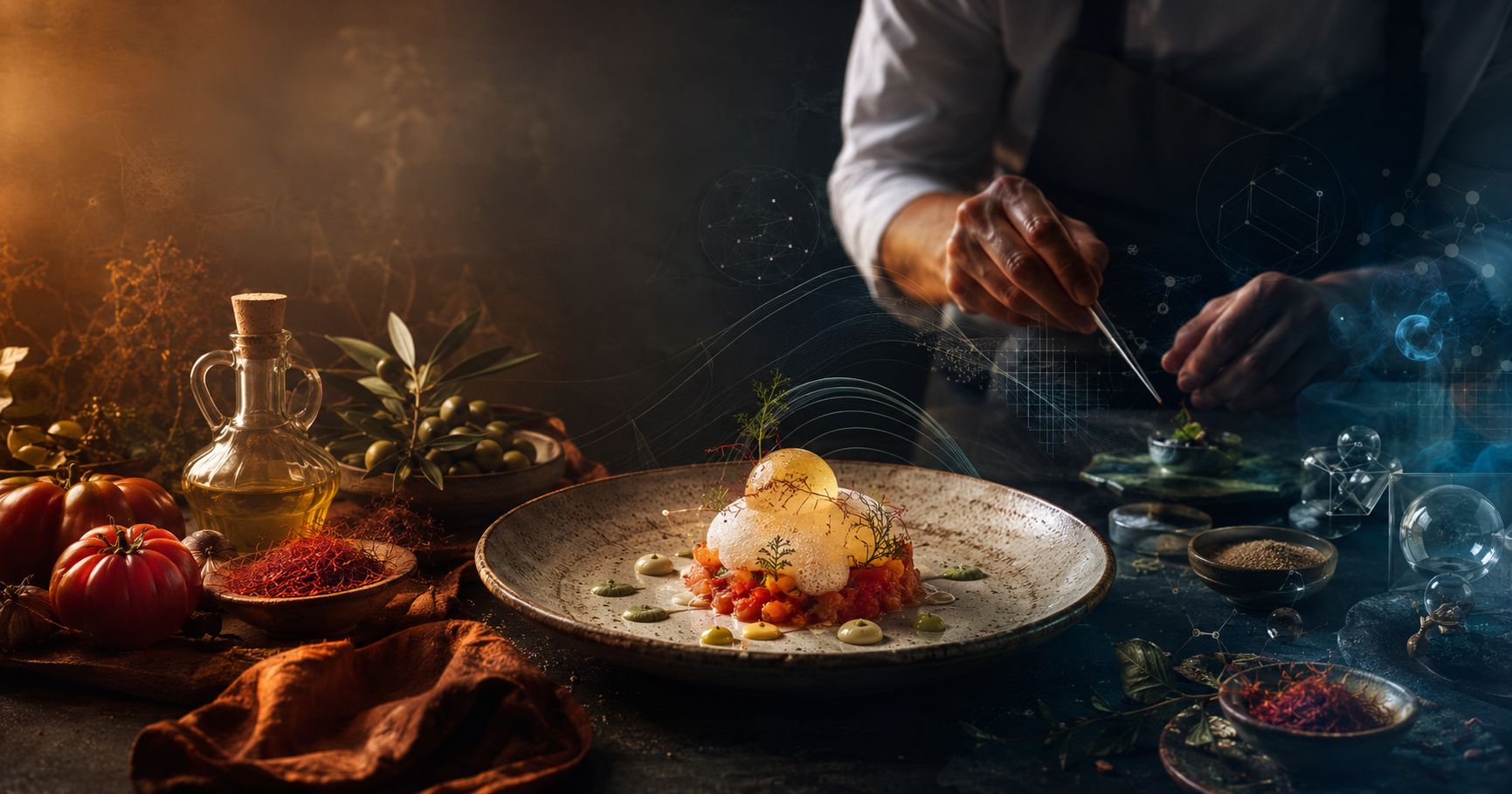
Chefs began collaborating with chemists, physicists, designers and artists. Taste became a field of research – not in order to replace tradition, but to understand it more deeply.
And Spain’s culinary transformation did not end with Ferran Adrià.
Martín Berasategui elevated product quality and precision to the highest level. The Roca brothers connected cuisine with emotion, memory and multisensory experiences. Andoni Luis Aduriz challenged established habits and turned the guest into an active participant in the culinary experience.
Each of them spoke a different culinary language, yet they were all telling the same story:
Taste is more than flavour. It is memory and emotion. It is culture and science. It is design and communication.
Today, when we talk about taste, we are no longer talking only about food. We are talking about how people experience products, how colours create expectations, how sound influences our perception of flavour and how a plate can tell a story. We are talking about the ways in which packaging, light, materials, aromas and even the sequence of a menu can shape the way we perceive an experience.
Taste never exists in isolation. It emerges through the interaction of many different disciplines.
Looking back at the development of Spanish cuisine today, I realise that its greatest contribution was not simply the creation of new dishes. It showed us what becomes possible when people from different disciplines think and work together.
This idea lies at the heart of Globe of Taste.
Not as a network exclusively for chefs, but as a platform for everyone who explores taste from a different perspective: chefs, designers, scientists, food producers, sensory experts, winemakers, craftspeople, psychologists, marketers and packaging specialists.
Because the most exciting innovations almost always emerge where different ways of thinking come together.
Spanish cuisine showed us what becomes possible when curiosity becomes more important than habit – without ever losing sight of tradition.
Perhaps that is its most important message:
Innovation does not mean replacing the old.
Innovation means understanding the old so deeply that something new can grow from it.
And that is where Taste begins for us.