By Christoph Büchner
Trust rarely begins with facts. It begins with a feeling. And hardly any other sense triggers this feeling as immediately as taste. Even before we read an ingredients list, check a quality mark or learn about a producer’s story, our brain has often already formed a judgement: this feels right. Or it doesn’t.
Modern consumer research shows that taste is far more than just a criterion for enjoyment. It influences our perception of quality, authenticity, safety and credibility. In other words: taste can build trust.
The psychology of the first bite
Food is one of the few products whose quality we can assess directly through our senses. At the same time, many characteristics remain invisible. Where do the ingredients come from? Was it produced sustainably? Do the quality promises match reality?
In this climate of uncertainty, taste serves as a guide. Consumers use sensory impressions as indicators of trust. If a product is perceived as harmonious, high-quality and authentic, the likelihood increases that the brand, origin and manufacturer will also be viewed more favourably.
A study on mineral water even showed that well-known brands can make identical products appear to taste better. Trust therefore influences taste. At the same time, a positive taste impression in turn strengthens trust. A cycle of mutual reinforcement emerges.
The taste of reliability
Of particular interest is the question of which flavour profiles foster trust.
The answer is surprising: it is not exceptional intensity, but recognisability that is decisive.
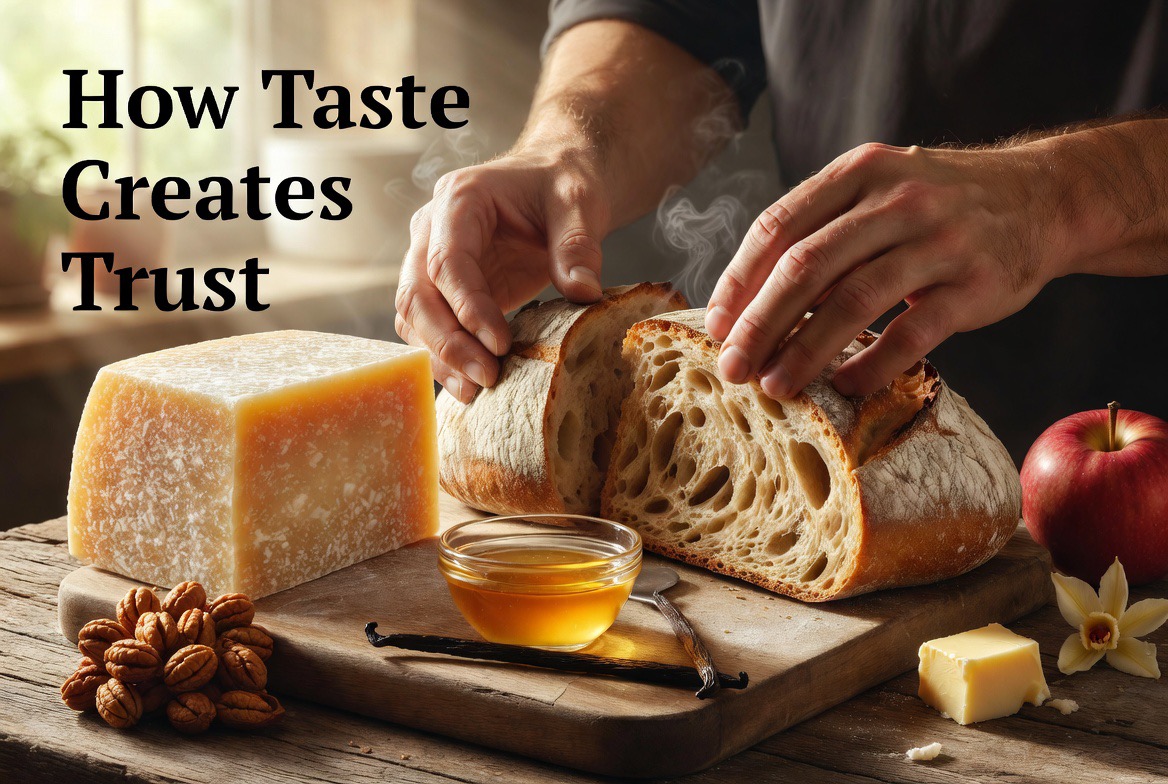
People trust, above all, flavours that meet their expectations. Sourdough bread may be slightly sour. Parmigiano Reggiano should be strong and rich in umami. An apple should be fruity and fresh. When taste and expectation align, a sense of reliability arises.
In this context, sensory experts refer to the so-called ‘mere exposure effect’: things we experience frequently become familiar to us and, as a result, more appealing. Repeated positive taste experiences foster loyalty and, in the long term, trust.
The key ‘trust-inspiring’ flavours
Certain flavours recur across cultures as positive signals of trust:
fresh bread and bread crust
vanilla
butter
roasted nuts
honey
apple
mild sweetness
umami-rich ingredients such as mature cheese or mushrooms
The reason lies less in chemistry than in human experience. These flavours have been part of many people’s lives since childhood. They represent family, a sense of security and reliability. The brain associates them with positive memories.
One might say:
Trust arises where taste becomes memory.
Is there a universal flavour of trust?
The answer is: no.
Trust does not have a universal flavour. It is culturally shaped.
In Europe, trust is often built on provenance and tradition. A regional cheese, artisan-baked bread or a protected olive oil benefit from the link between the product and the region. Provenance becomes a mark of credibility.
In North America, by contrast, a product’s consistency often plays a particularly important role. Consumers expect a product to taste exactly the same today as it did yesterday. Consistent quality builds trust in the brand.
In East Asia, harmony and umami are often key indicators of quality. Dashi, miso, seaweed and fermented products are seen there as symbols of artisanal skill, depth and balance.
Latin American consumers often associate trust with freshness. Fruit, acidity, herbs and freshly prepared dishes convey naturalness and authenticity.
In the Middle East, on the other hand, spices such as cardamom, cinnamon or notes of dates play an important role, often embedded in cultural notions of hospitality and community.
However different these flavour worlds may be, they follow the same principle:
People trust flavours that confirm their cultural expectations.
Why authenticity is becoming more important
In a globalised food world, the desire for transparency and the quest for authenticity are growing. Consumers are increasingly looking for products that tell a traceable story.
But stories alone are not enough.
If a product promises origin, craftsmanship or tradition, it must also convey these values through its flavour. Only when the message and the sensory experience align does genuine trust arise.
This is precisely where the challenge of modern food culture lies: trust cannot be printed on a label. It must be tangible through taste.
Conclusion
Taste is far more than mere enjoyment. It is a social, cultural and emotional signal. We trust food not only because of its ingredients or certifications, but because it fulfils expectations, evokes memories and conveys reliability.
The taste of trust may be that of Parmigiano in Italy, dashi in Japan, sourdough bread in Germany.
What remains the same everywhere is the human need for guidance. And taste often satisfies this need more quickly than any label.
Trust has no universal taste. But all over the world, it tastes of authenticity.