By Ernest Jagodziński
When I ask young chefs what has the greatest influence on the flavour of a dish, I almost always hear the same answers.
Salt.
Pepper.
Butter.
Spices.
Fermentation.
Very rarely does anyone answer:
Temperature.
And yet, temperature is one of the most underestimated variables in cooking.
Interestingly, you will never find temperature listed in a recipe as an ingredient. You cannot buy it at a market or a grocery store. It does not sit on a shelf next to salt or olive oil.
It is invisible.
Yet every day, it influences what we smell, what we taste, what we feel in our mouths — and ultimately, what we remember.
It is no coincidence that Champagne is served chilled, espresso is served hot, and butter is taken out of the refrigerator before serving.
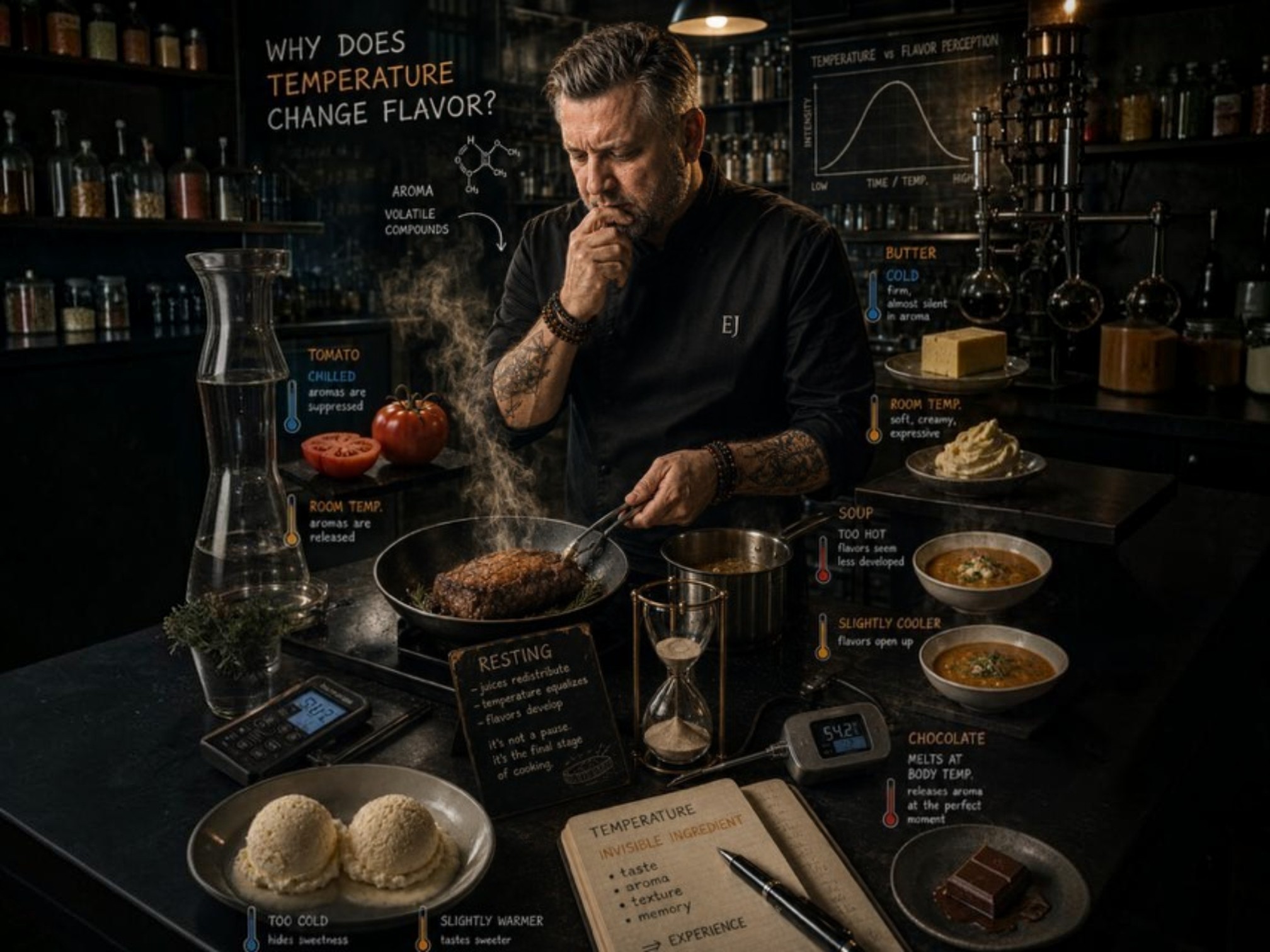
Nor is it a coincidence that a tomato kept too cold can seem less aromatic than one brought back to room temperature.
Temperature does not only change the product.
Temperature changes the way we experience the product.
For many years, I considered temperature primarily a tool for controlling the cooking process.
It determined the doneness of meat, the consistency of a sauce and the safety of food.
Only with time did I realise that temperature has another, equally important role.
It determines what becomes available to our senses.
Imagine a simple experiment.
Two identical portions of vanilla ice cream.
One is served straight from the freezer.
The other is allowed to soften for a few minutes.
The ingredients are identical.
The amount of sugar is exactly the same.
Yet the second portion will often be perceived as sweeter and more aromatic.
Does it actually contain more sugar?
Of course not.
Only the temperature has changed.
And something has changed in us as well.
Temperature can influence both the physical behaviour of flavour compounds and the way our sensory system responds to them. Studies have shown, for example, that perceived sweetness can be lower in colder foods and higher as the food temperature rises.
This is why serving temperature is not simply a matter of comfort.
It is part of flavour design.
The same principle can be seen with tomatoes.
When tomatoes are stored at low temperatures, the release and production of many volatile aroma compounds can decrease. Research has shown that refrigeration can substantially alter the tomato’s volatile profile and reduce the intensity of aromas associated with ripe tomato flavour.
The tomato has not suddenly lost all of its flavour.
But the way that flavour reaches us has changed.
And because so much of what we call flavour is closely connected to aroma, the difference can be surprisingly large.
This is an important distinction:
Temperature does not always change what is in the food. Sometimes it changes what becomes perceptible.
The same idea applies to butter.
Cold butter is firm and releases its aroma differently.
As it approaches room temperature, it softens, melts more readily in the mouth and becomes more expressive.
The composition has not suddenly changed.
The sensory experience has.
Fat, texture, aroma and temperature begin working together.
This is why the same ingredient can feel completely different depending on when and how we serve it.
In a professional kitchen, this becomes a powerful tool.
We often speak about temperature as if it were simply a technical parameter:
52°C. 58°C. 64°C. 72°C.
But a temperature is not just a number.
It is a sensory decision.
Take a steak.
One of the most common instructions in a professional kitchen is:
“Let the steak rest.”
For years, the explanation was often simple:
“Let the juices redistribute.”
The reality is more nuanced.
Resting changes the temperature profile of the meat. Heat continues to move from the hotter regions toward the cooler surface, while the structure of the meat continues to change.
The final result depends on the thickness of the meat, the cooking method, the endpoint temperature and the amount of heat retained.
And there is another important point:
Resting is not automatically a guarantee of a better steak.
Recent research on beef roasts found that resting changed where moisture was lost — more during resting, less during slicing — but did not produce a significant overall improvement in palatability.
That does not make resting irrelevant.
It makes it more interesting.
Because the chef’s question should not simply be:
“Should I rest it?”
It should be:
“What do I want the guest to experience when I serve it?”
Temperature is part of that answer.
The same principle applies to fish.
Fish is remarkably delicate. Its texture changes rapidly with heat, and its final eating quality depends strongly on the temperature it reaches and the way that heat is transferred through the flesh.
A few seconds can make the difference between delicate and dry.
Between translucent and opaque.
Between supple and firm.
Temperature is not simply telling us whether the fish is cooked.
It is helping determine what the fish becomes.
Soup offers another simple example.
Serve the same soup extremely hot and the first impression may be dominated by heat.
Allow it to cool slightly and suddenly different layers can appear.
Herbs become more noticeable.
Fat becomes more expressive.
Aromas become easier to perceive.
The flavour has not necessarily become stronger.
Our access to it has changed.
Chocolate gives us perhaps the most obvious demonstration.
At body temperature, chocolate softens and melts, releasing aromatic compounds while changing its texture in the mouth.
The experience is completely different from tasting the same chocolate directly from a cold environment.
Again:
Same ingredient.
Different temperature.
Different perception.
This is not coincidence.
It is sensory science.
Aroma compounds are volatile molecules. Their release and movement are influenced by temperature, which is one reason warmer foods often produce a stronger immediate aroma. But temperature also affects viscosity, melting behaviour, texture and the way our sensory receptors respond.
And this is where cooking becomes particularly fascinating.
Flavour is never only about what happens on the tongue.
It is a collaboration between:
taste, aroma, temperature, texture, trigeminal sensation and memory.
The chef therefore has more control than simply adding another gram of salt.
Sometimes the most important decision is not:
“What should I add?”
It is:
“At what temperature should I serve it?”
This changes the way I think about recipes.
A recipe can tell you:
Add 4 grams of salt.
Cook for 6 minutes.
Bake at 180°C.
But perhaps an equally important instruction is missing:
Serve at 55°C.
Or:
Allow to rest for 4 minutes.
Or simply:
Do not serve it straight from the refrigerator.
These details may never appear in the ingredient list.
But they can determine the final experience.
Temperature is therefore not merely a cooking parameter.
It is part of the composition.
It is part of the timing.
It is part of the flavour.
And perhaps most importantly, it is something that affects both sides of the equation:
the food and the person eating it.
The food changes.
Our perception changes.
And somewhere between the two, flavour happens.
Perhaps temperature will never appear next to salt, pepper or olive oil in a recipe.
You will never buy it in a shop.
Yet every single day, it shapes the way we experience food.
Perhaps temperature is not merely a cooking parameter.
Perhaps it is one of the most important seasonings a chef can use.
Only…Invisible.
“Not everything that changes flavour can be added to the pan.”