TEXTURE – WHEN TASTE BECOMES PHYSICAL
By Florian Schwarz
Over the past weeks, I have been following several conversations within Globe of Taste that made
me think about how many things influence our experience of food before we finally decide whether
something simply “tastes good.” Christoph explored the influence of colour, Ernest looked at
temperature and its effect on flavour, while Yana raised the thought that the same taste does not
necessarily create the same experience. In my last article, I wrote about aroma and something we
experience every day as chefs: we smell before we taste, which means that by the time the first bite
reaches our mouth, our expectations have already begun to shape the experience.
All of this made me think about another element that we chefs work with every day and that
deserves much more attention when we talk about taste: texture.
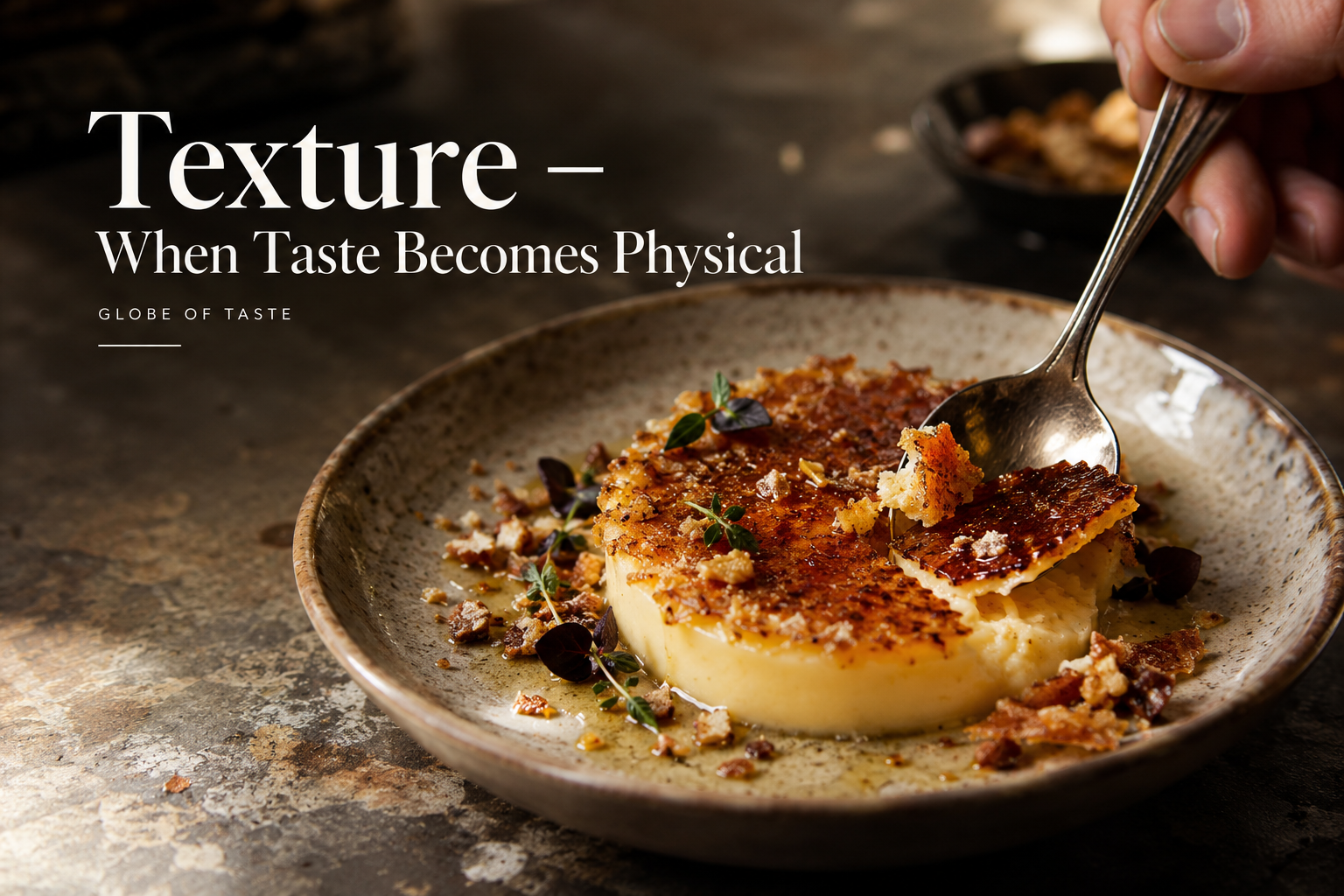
A creme brulee is perhaps one of the easiest examples. The custard can have exactly the right
sweetness, a beautiful vanilla flavour and perfect balance, but imagine eating it without that thin
caramel layer on top, without the resistance of the spoon and that unmistakable crack before
reaching the soft cream underneath. The flavour has hardly changed, and yet something essential
about the experience has disappeared. The same principle applies to crisp fish skin, a French fry
that has lost its crunch or freshly baked bread whose crust gives way to a soft centre. Part of what
makes these foods enjoyable is not flavour in the narrow sense, but what happens physically in the
mouth.
What interests me even more as a chef is what happens when several textures meet in the same
dish. Something crisp beside something creamy can make both elements more noticeable;
something rich and melting can feel completely different when it meets something fresh and firm.
We have all eaten dishes where every component was technically good, yet everything had roughly
the same consistency and after a few bites the plate became strangely monotonous. A
well-considered contrast of textures can give a dish a kind of rhythm, changing the experience from
one bite to another and sometimes even within the same bite.
I can see the importance of texture very clearly in my own memories of food. There are dishes I was
given as a child, either at home or at my grandmother’s, that I still remember today. Looking back as
a chef, I am quite sure that some of them were actually very well prepared and probably tasted
perfectly good, but as a child I simply couldn’t get past the texture. Something was too soft, too
slippery, too fatty or had a consistency I found unpleasant, and once that feeling had become
connected to the dish, the flavour almost didn’t matter anymore.
What fascinates me is that some of these associations have stayed with me until today. Decades
later, with all the experience I have gained as a chef and a completely different understanding of
ingredients and cooking, the name of a particular dish can still bring back that first physical reaction.
Rationally, I know that I might enjoy the flavour today, but somewhere in my memory the texture still
belongs to that childhood experience. Texture therefore does not only influence whether we enjoy a
particular bite; it can become part of how we remember the food itself.
Thinking about this brought me back to an earlier article I wrote about Ferran Adria and the
extraordinary period when Spanish cuisine began questioning many of the rules that had defined
fine dining for generations. Looking back, it is easy to focus on the spectacular techniques and
overlook the more interesting question behind them. Adria and the chefs around that movement
were not simply asking what new flavours they could create; they were also asking what would
happen if a familiar flavour suddenly reached us in a completely unfamiliar physical form.
Foams, airs, gels and spherification became visible expressions of this thinking. A familiar
ingredient could become almost weightless, a liquid could be enclosed in a delicate membrane and
burst in the mouth, while something expected to be solid might arrive as a cream, foam or gel. At its
best, this was not technique for the sake of spectacle. It made us reconsider how much our
experience of an ingredient depended on the texture we expected it to have.
Most chefs, of course, do not need spherification or a collection of hydrocolloids to understand this
principle. We have been manipulating texture for as long as people have been cooking. We roast,
fry, whip, emulsify, reduce, dry, freeze and ferment; we turn something soft into something crisp,
something firm into something creamy and something dense into something light. Often we do it
almost instinctively because experience has taught us that the way food feels in the mouth can be
every bit as important as the way it tastes.
The longer I cook, the more I think of texture not as something that simply accompanies flavour, but
as something that helps create the experience we eventually describe as flavour. It is where food
becomes physical, where what we smell and taste is joined by what breaks, melts, crunches,
stretches or bursts in our mouth. And after the recent discussions within Globe of Taste about
colour, temperature, aroma and perception, perhaps this leads us to a much larger question:
When we say that something tastes good, how much of what we are describing is actually
taste?
Florian Schwarz
overlook the more interesting question behind them. Adria and the chefs around that movement
were not simply asking what new flavours they could create; they were also asking what would
happen if a familiar flavour suddenly reached us in a completely unfamiliar physical form.
Foams, airs, gels and spherification became visible expressions of this thinking. A familiar
ingredient could become almost weightless, a liquid could be enclosed in a delicate membrane and
burst in the mouth, while something expected to be solid might arrive as a cream, foam or gel. At its
best, this was not technique for the sake of spectacle. It made us reconsider how much our
experience of an ingredient depended on the texture we expected it to have.
Most chefs, of course, do not need spherification or a collection of hydrocolloids to understand this
principle. We have been manipulating texture for as long as people have been cooking. We roast,
fry, whip, emulsify, reduce, dry, freeze and ferment; we turn something soft into something crisp,
something firm into something creamy and something dense into something light. Often we do it
almost instinctively because experience has taught us that the way food feels in the mouth can be
every bit as important as the way it tastes.
The longer I cook, the more I think of texture not as something that simply accompanies flavour, but
as something that helps create the experience we eventually describe as flavour. It is where food
becomes physical, where what we smell and taste is joined by what breaks, melts, crunches,
stretches or bursts in our mouth. And after the recent discussions within Globe of Taste about
colour, temperature, aroma and perception, perhaps this leads us to a much larger question:
When we say that something tastes good, how much of what we are describing is actually
taste?
Florian Schwarz
Globe of Taste