By Georges Geeraerts (Honorary Member – Globe of Taste)
Vanilla is one of the world’s most iconic flavouring ingredients and arguably the most widely used aroma in both the food and fragrance industries. Much has been written about the “Queen of Spices”, but this first contribution aims to highlight a few essential facts.
Vanilla was first cultivated and appreciated by the Aztecs, who used the pods of an orchid vine native to Mexico. The spice was later introduced to Europe by the Spanish conquistadors during the 16th century.
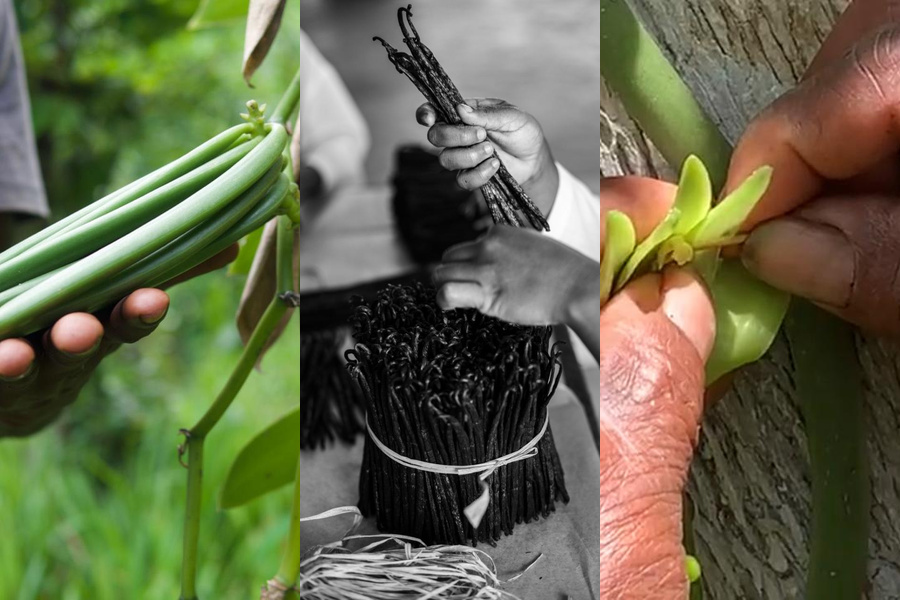
Producing natural vanilla is an exceptionally long and demanding process. Outside its native Mexico, where the Melipona bee naturally pollinates the flowers, every vanilla blossom must be pollinated by hand. Madagascar, now the world’s leading producer of Vanilla planifolia, relies entirely on this delicate manual operation.
The pods are harvested approximately nine months after pollination, when they begin to turn yellow-green. They then undergo a meticulous curing process lasting up to six months. This includes scalding, sweating, slow drying and careful conditioning, all of which transform an almost odourless fruit into one of the world’s most complex natural flavourings.
Natural vanilla contains more than 200 aromatic compounds working together in perfect harmony. Vanillin is the dominant molecule, but it represents only one element of a remarkably rich and sophisticated aromatic profile.
Because natural vanilla requires extensive manual labour and months of careful preparation, it has traditionally been considered a premium ingredient. Today, however, market imbalances caused by periods of oversupply—or, depending on one’s perspective, insufficient consumption—have significantly reduced producers’ returns. Long before this situation, chemists had already sought more economical alternatives to natural vanillin.
Vanillin can now be produced from several different sources. It may be derived from natural raw materials such as eugenol from cloves or ferulic acid from rice bran, but it can also be synthesised from petrochemical feedstocks. Although chemically similar to the principal molecule found in vanilla, synthetic vanillin delivers only a single aromatic note. It lacks the richness, depth and elegance of genuine vanilla.
The next time you choose a vanilla ice cream, a dessert or a pastry, take a moment to consider not only the flavour but also the remarkable journey behind every natural vanilla bean. By choosing real vanilla, you reward an extraordinary agricultural tradition, preserve exceptional craftsmanship and contribute directly to the livelihoods of thousands of smallholder farming families.
Georges Geeraerts
Honorary Member – Globe of Taste
President – GEVM (Groupement des Exportateurs de Vanille de Madagascar)
More insights into the fascinating world of vanilla will follow in future articles.