How place, perception and expectation shape what we drink
By Raúl Ferreira
Have you ever noticed that a wine can seem to taste better in the place where it comes from?
Take Alvarinho.
Imagine a cold glass in Portugal, near the Atlantic, with grilled octopus, excellent olive oil, warm weather and a long lunch ahead.
Now drink the same bottle on a cold, wet afternoon in Scandinavia, alone, with darkness outside.
The wine hasn’t changed.
But the experience has.
We often think of taste as something that belongs entirely to the liquid. Acidity, fruit, alcohol, aroma, balance.
But we never experience a drink in isolation.
We experience it through the place, the food, the glass, the colour, the name, the people, the music, our memories and, most importantly, our expectations.
The brain doesn’t simply receive flavour. It interprets it.
I have a very personal example.
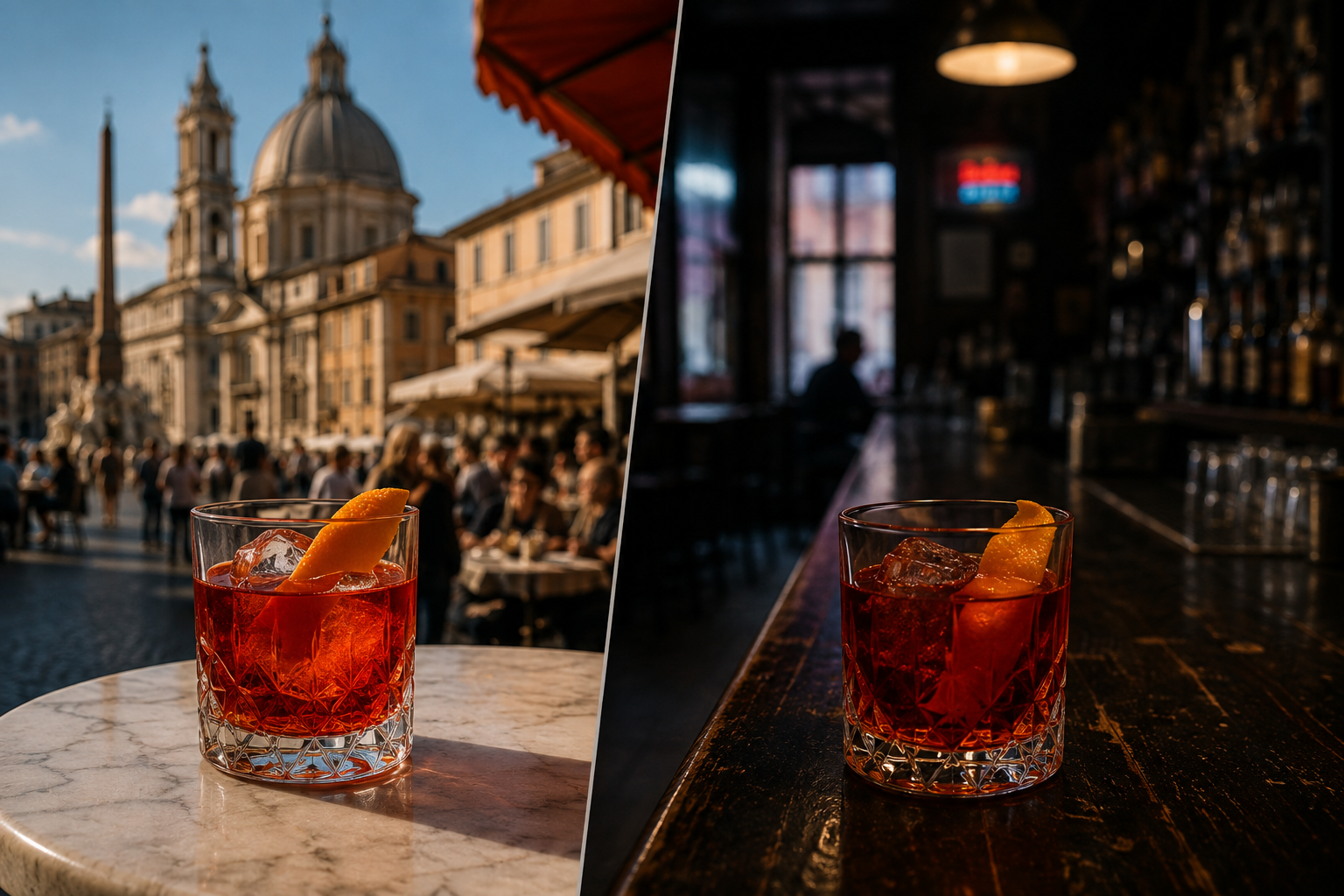
My first Negroni was in Piazza Navona in Rome in 2007.
I still love Negroni.
Was it objectively better than every Negroni I’ve had since? Of course not.
But Rome became part of that drink. The architecture, the atmosphere, the Italian aperitivo culture and the feeling of being there for the first time became part of my experience of it.
Now imagine an equally good Negroni at 3 PM in a dark dive bar, prepared in a completely different way, with no connection between the drink and the moment.
It might still be a perfectly good cocktail.
Yet somehow, it could feel like a waste of a good product.
Why?
Because we aren’t only tasting the drink.
We’re tasting the context.
A cocktail begins before the first sip. Its colour creates an expectation. Its name creates another. The glass, temperature, ice, music and environment continue the story.
And then there is memory.
A drink can become attached to a place, a person or a moment. When that happens, we don’t just remember the flavour. We remember the experience.
Branding works in much the same way.
A familiar name can create expectations of quality, authenticity, aspiration or belonging before the bottle is even opened.
So how much of what we call “better taste” is created before we actually taste anything?
Of course the liquid matters. Ingredients, technique, balance and quality matter enormously.
But perhaps taste is not simply what is inside the glass.
Perhaps it is everything we bring to it.
We arrive with memories, culture, preferences and expectations. The bartender, sommelier and brand add another layer through presentation, language, environment and storytelling.
And somewhere between all these signals, the brain creates what we experience as taste.
Perhaps the most interesting ingredient in any drink is the one we never see on the menu:
expectation.
We bring it with us.
And then we take a sip.
We call the result taste.