Beyond Taste – Why One Perspective Is Never Enough
By Florian Schwarz
Over the past months, we have explored several fascinating aspects of taste through our articles and discussions at Globe of Taste. From umami and kokumi to the remarkable influence of aroma and texture, and from the role of colour and temperature to cultural expectations and consumer behaviour, each contribution has offered another perspective on something we experience every day.
Although these subjects may appear quite different, they have gradually led us towards a common understanding: what we experience as taste is far more complex than the flavour of an ingredient itself.
A product can be technically excellent, carefully developed and beautifully balanced, yet still fail to create the response its producer had hoped for. Something that feels familiar and comforting in one country may seem unusual in another. A level of sweetness that appeals to one group of consumers might be overwhelming to another, while a texture that one culture appreciates could be the very reason another rejects the product.
Our experiences across different countries, cultures and professional disciplines have shown us that there is rarely one universally correct answer to what tastes good. We all carry our upbringing, memories, cultural habits and personal expectations with us, and these influence our experience long before we consciously begin to evaluate what we are eating or drinking.
This becomes particularly interesting when we look beyond restaurants and consider the enormous world of food and beverage products.
Imagine a company developing a new beverage. The flavour may be perfectly balanced according to its development team, but how will consumers in different countries perceive its sweetness, acidity or bitterness? Does the packaging communicate the experience the product actually delivers? Will its colour, name or presentation create expectations that the product can fulfil? And could something that works extremely well in one market benefit from a different approach somewhere else?
These questions are difficult to answer from a single professional or cultural perspective, regardless of how experienced that person may be.
And this is precisely where the idea behind Globe of Taste begins.
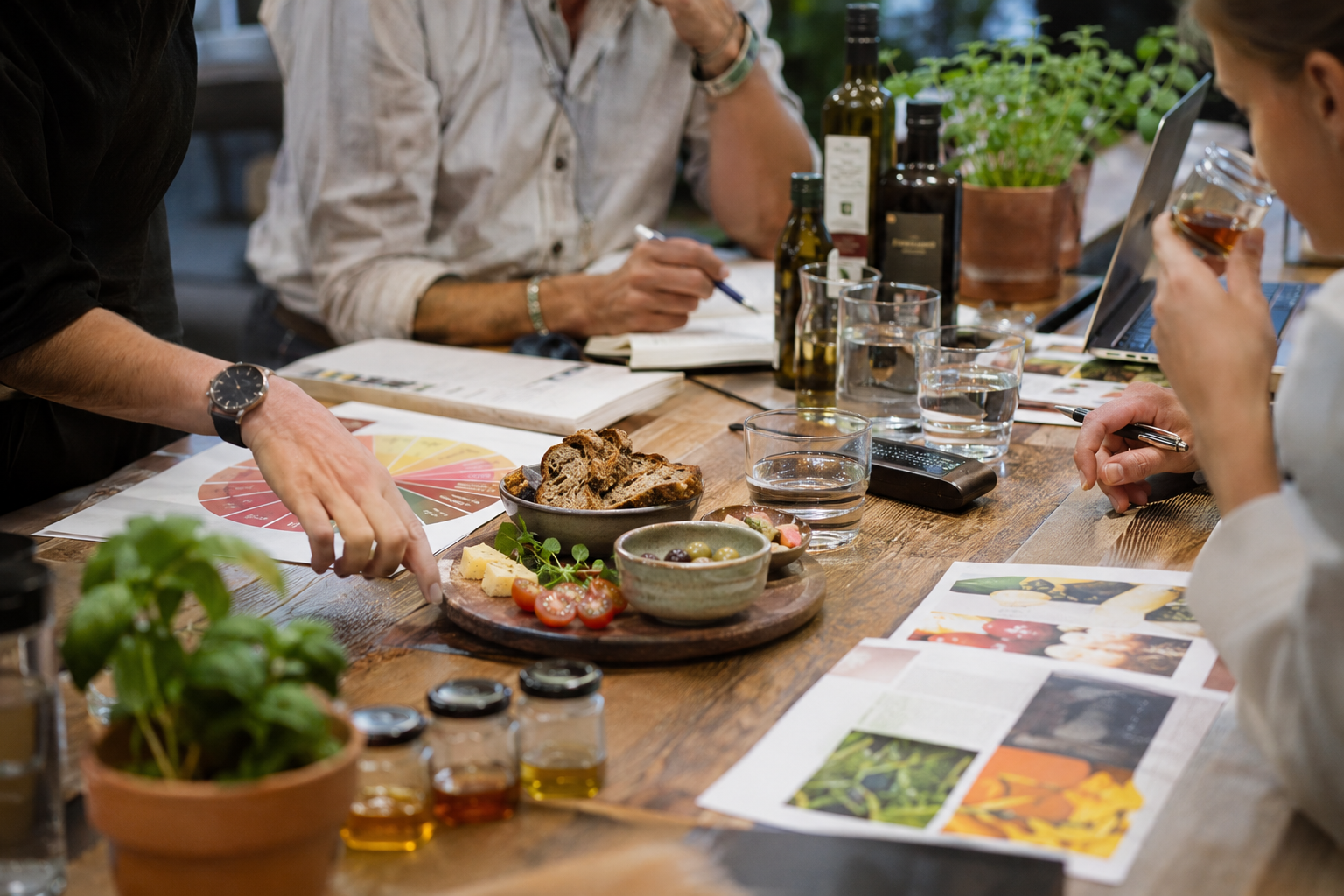
We are building an international network of professionals whose experience reaches across culinary arts, beverages, food science, product development, design, marketing and different cultural markets. Each member contributes a particular background, professional expertise and understanding of what makes a product successful.
A culinary professional might notice the balance of flavours or the way a texture develops in the mouth. A beverage specialist may recognise something entirely different in the same product. Someone working in science or product development may question its formulation, while a design or marketing professional may see a disconnect between the product itself and the expectations created by its packaging.
None of these perspectives is necessarily more important than another. Their value lies in bringing them together.
What interests us most about this approach is that we are not trying to establish a universal definition of good taste. We want to understand why a product works, for whom it works, where it might encounter difficulties and what could be improved.
Our ambition is to develop a collaborative evaluation process through which food and beverage companies can receive an independent, internationally informed assessment of their products. Rather than simply assigning a score or declaring something good or bad, the aim is to identify strengths, recognise potential weaknesses and offer constructive suggestions that can help a product develop further.
This may involve flavour, aroma and texture, but also presentation, packaging, consumer expectations and the differences between individual markets. Sometimes the most valuable observation may have very little to do with changing the recipe itself.
We are currently developing and testing this approach, working towards a common evaluation framework that allows our different areas of expertise to contribute to one coherent result. This is an important stage for us, because bringing together professional opinions from different countries is one thing; transforming them into clear, practical and useful recommendations for a company is another.
Our vision is for Globe of Taste to become more than a place where professionals exchange interesting thoughts about food and beverages. We want to create an international platform where knowledge, cultural understanding and professional experience come together to help companies understand their products from perspectives they may not have considered before.
Looking back at our previous discussions about aroma, texture, colour, temperature and cultural expectations, we can see them as individual pieces of a much larger picture. Each one explains something about how people experience products, but none of them tells the whole story on its own.
Perhaps the most interesting question for a food or beverage producer is therefore not simply whether a product tastes good.
It is whether the people it was created for will experience it in the way its producer intended.
And sometimes, understanding that difference requires more than one perspective.
Globe of Taste
Different perspectives. A deeper understanding of taste.